
How to Grow Your Business Without Being Ruled by Stress
What is the Founder EQ Model?
Introduction
If you are the founder of a company with 10–20 employees, doing seven figures in top-line revenue per year, but finding it difficult to grow lately, the solution to unlocking growth again may be unexpected but very much within reach.
If managing your team feels emotionally draining, frustrating, or consistently stressful, this is for you.
If you find yourself avoiding difficult conversations, procrastinating, or distracting yourself from the parts of running a business you know you’re avoiding, keep reading.
If you feel like an imposter—worried that you’ll be exposed any day now as a terrible leader—don’t worry. You’re not alone. And you’re going to learn how to work through that in this guide.
Do you feel paralysed when difficult decisions need to be made? Unsure what answers to give your team when everyone is looking to you for clarity, direction, and accountability?
If you feel stressed and overwhelmed running your company, please read on.
If you find leadership lonely, this is for you.
My name is Dylan. I have a postgraduate qualification in applied psychology, and I work with founders to help them become better leaders by increasing their emotional intelligence—and, by doing so, grow their companies more effectively, without the chronic stress that turns into burnout, or worse, apathy and depression.
This guide will show you essential leadership psychology that will make running your company feel less stressful, less lonely, and less emotionally heavy.
Many first-time founders are never taught the so-called “soft skills” of leadership. That’s not your fault. You’re learning the art of leadership on the job. I’m not for a second trying to suggest that I’m a leadership guru—but I do know, with confidence, that emotional intelligence is a foundational skill for leaders, and for humans in general. When you’re the “boss,” it matters even more. The buck stops with you, and so do the pressures.
If any of this resonated, know this: you’re not broken, you’re not failing, and you’re not alone—and what follows will help you understand what’s really been driving the patterns holding you back, and how to change them.
You’ll learn how to notice the ways your emotions impact your leadership effectiveness. Through enhanced self-awareness, you’ll increase your agency in how you respond to the difficult challenges that come with running a company, leading a team, and growing your business into the one you’re working towards.
The Founder EQ Model In A Nutshell
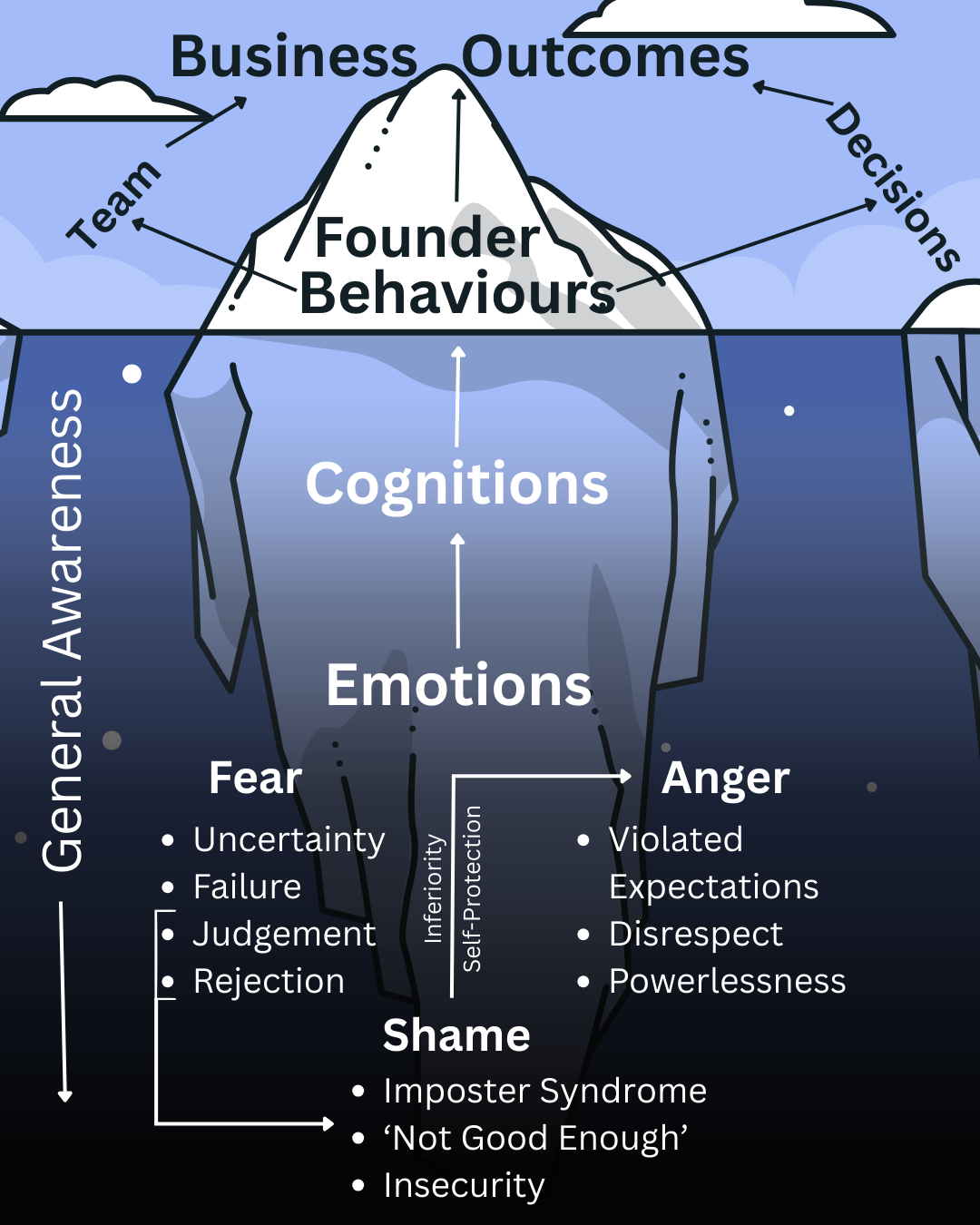
A founder’s behaviour is a high-leverage resource in any small business. Your actions significantly determine how your business grows—or doesn’t grow.
Your behaviour is the first domino. A ripple that moves outward through the company. And it shows up two key ways:
A founder’s behaviour shapes team relationships—and therefore team performance.
A founder’s decisions shape business outcomes. Decision-making is embedded in strategy, mission, vision, values, goals, and how all of these are executed—including what you decide to focus on at any given moment.
Sometimes founders behave in ways that are misaligned with the goals and outcomes they’re trying to achieve—whether they realise it or not. It can feel as though you know what you should be doing, yet can’t break the cycles of doing (or not doing) the very things you know are best for you or your company.
At other times, you’ve already done or said the thing before you’ve even realised its impact.
And again, that’s not your fault. You haven’t been taught how to recognise—or have agency over—how your emotions shape your thoughts and behaviours. This is a learned skill. One that requires practice.
Behaviour, relationship dynamics, and decision-making don’t appear out of nowhere. They’re shaped by:
how you are thinking in the moment
and, more importantly, which emotions are influencing that thinking—often without being noticed
Here’s the thing: emotions like fear, shame, and anger don’t always scream loudly. They don’t come with a universal bodily signal or a magical lightbulb that goes off to announce their presence.
Founder EQ is about understanding what’s happening under the surface, before it leaks into your actions and undermines your relationships, your ability to think strategically, and your capacity to lead your team and grow your business effectively.
Stress is killing your potential—as a business owner, a leader, and a human being. Let’s eliminate as much of the overwhelm as we can, so you can show up as the best leader for your business. So you can grow your company into the business you’ve been working towards. And most importantly, so you can have a positive impact in the world, and on the people who help build your vision with you every day.
How The Founder EQ Model Works
“Who we are is how we lead” - Brene Brown.
The Founder EQ model is represented as an iceberg. A founder’s behaviour sits at the top, above the waterline, because behaviour exists in the observable world.
How you behave impacts your team, your decisions, what you focus on, and ultimately whether you reach your desired business outcomes. The iceberg can rise, or it can sink. And as much as you want it to rise toward your goals, there are forces beneath the surface that can weigh you down and hinder your progress.
Underneath the surface are cognitions. Your thoughts. These are not observable to the outside world unless you communicate them, which then becomes behaviour. Thoughts are often recognisable as your internal dialogue. However, emotions influence thinking in predictable ways. I believe feelings such as fear, shame and anger can lead to cognitive distortions. I did not create these distinctions. They come from cognitive behavioural therapy (CBT) through the work of Aaron Beck.
This is not to say emotions are outside awareness. Of course we know when we are pissed off, worried or stressed. But what about the underlying causes of those reactions?
For example, a founder has an implicit expectation about how a team member should be working. The expectation is never clearly communicated. The team member falls short. The founder feels frustrated. Instead of addressing it calmly and openly, the founder avoids the difficult conversation, quietly resenting the team member instead. They take the task back. They keep the work on their own plate. Over time, they feel increasingly stressed and overworked. Growth slows. The business does not move as quickly as it could. All of it rooted in unexamined anger.
Or consider a founder who carries a subconscious fear of uncertainty rooted in financial instability growing up. Now they are facing a difficult cashflow month. From that fight-or-flight place of fear, they avoid looking closely at the numbers. Or they swing into panic.
In that panic, they take on a poor-fit client just to relieve the immediate pressure. They make short-term decisions that reduce discomfort in the moment but create long-term damage.
If the founder is paying attention to their thinking, they may notice catastrophising thoughts, which we will explore later. The dominant narrative becomes that uncertainty equals disaster. The mind fills in the gaps with worst-case outcomes when faced with the unknown.
In the diagram above, emotions sit at the deepest level. Not because we are oblivious to how we feel. That is not the claim. I take the stance that emotions are the root. The initial reaction that sets off a chain of thoughts and actions, or inactions. Emotions ignite before we think. Before we act. They shape how we interpret and respond.
They are also harder to identify clearly than behaviours and thoughts, especially if we lack somatic awareness. I am not suggesting you are oblivious to how you feel. I am making a case for leverage. If you want meaningful change, dig down to the roots and observe how the rest of the system is affected.
This model shows a maladaptive leadership pattern. If left unchecked, emotions such as fear, shame and anger reduce your agency over your thoughts and behaviours. You become reactive. You behave in ways that are counterproductive to building the business you want.
Here is the thing. You know when you are behaving in ways you do not respect. The conversations you avoid. The decision paralysis. The micromanagement. The difficulty delegating and letting go of the vine. Yet in the moment, it can feel as though your patterns have power over you.
This model is about identifying those patterns so you can increase your agency and interrupt them. Or put more plainly, free yourself from behaving in ways you know are counterproductive, yet repeat anyway and regret later.
Let’s dig into how these behavioural patterns impact your ability to lead effectively and reach your business goals.
Behaviour
There are two core categories in which founders can behave maladaptively in ways that hurt business growth: control or avoidance. Either we act in ways that try to achieve or maintain control over the outside world, or we behave in ways that aim to avoid uncomfortable situations.
Here’s the uncomfortable truth you already know as a founder. How you act has a direct impact on your team relationships and where you place your focus. It also sets the tone for culture. My definition of culture is this: the behaviours your employees exhibit when they think no one else is watching.
Your behaviour indirectly shapes what your team believes is acceptable or unacceptable, regardless of what you explicitly say. You know you need to lead by example. You are not naive. The real question is whether you are leading by example when you feel stressed, frustrated, or under pressure.
Control and avoidance are forms of self-protection. They are armoured behaviours. Fight or flight responses translated into socially acceptable corporate patterns.
What Are Control Behaviours?
In reaction to fear, shame, or anger, trying to exert control over the environment is a common response. But how do you identify when control is healthy and when it becomes maladaptive? The distinction often comes down to intention and intensity, and ultimately the impact on your business.
Trying to manage internal discomfort by controlling the outside world can look like:
micromanagement
perfectionism
overworking
hyper-independence or difficulty delegating
coercive or overly assertive communication
frantic or excessive planning
covert manipulation
blaming others
These behaviours often stem from fear or anger, even when they present as “high standards” or high performance. Again, the distinction is one of intention and intensity.
What Are Avoidant Behaviours?
If control is one strategy for reducing discomfort, avoidance is another. Instead of trying to dominate the environment, a founder may try to escape it.
Avoidant behaviours can look like:
procrastination
distraction
passive aggression
avoiding difficult conversations
not asking for help
indecision or decision paralysis
These behaviours are often driven by the flight or freeze responses of the sympathetic nervous system.
It does not take much imagination to see how control and avoidance can damage the quality of team relationships required for growth, or reinforce a stagnant status quo. They influence what you do, what you delay, and what you never address.
This is the visible layer of leadership.
And it leads us below the surface, to the cognitions underneath, and how they influence behaviour.
Cognition
If behaviour is the visible layer of leadership, cognitions sit just beneath the surface.
Cognitions are your thoughts. The internal narratives, interpretations and assumptions running in the background while you lead. They are not directly observable unless you verbalise them, but they shape how you see situations, how you interpret events and how you decide what to do next.
In the Founder EQ model, we are not just interested in thoughts in general. We are interested in distorted thinking.
My stance is this: unexamined emotions such as fear, shame and anger create the perfect conditions for cognitive distortions. These emotions act like a greenhouse. When left unchecked, they grow patterns of thinking that are rigid, exaggerated or disconnected from reality.
This is not a theory I invented. The framework of cognitive distortions comes from cognitive behavioural therapy, originally developed by Aaron Beck. Founder EQ applies these distortions specifically to leadership and business decision-making.
When a founder is operating from unexamined fear, shame or anger, their thinking often becomes distorted in predictable ways. That distorted thinking then drives behaviour. And behaviour shapes business outcomes.
Below are the thirteen cognitive distortions most commonly identified in CBT. You may recognise some of them in your own internal dialogue.
All-or-nothing thinking
Overgeneralisation
Mental filter
Discounting the positive
Jumping to conclusions
Mind reading
Fortune telling
Magnification/Minimisation
Tunnel vision
Emotional reasoning
“Should” and “must” statements
Labelling
Personalisation and Blame
If you can begin to recognise distorted thinking when it arises, you interrupt the chain. You create space between emotion and behaviour.
And that space is where agency lives.
In the next section, we go deeper into the emotional layer. Because if distortions are the pattern of thinking, emotions are often the fuel.
Emotion
This is where Founder EQ actually lives.
Emotions such as fear, shame, and anger often activate before conscious thought. They arise quickly, automatically, and physiologically. They are not inherently good or bad. They are signals.
Fear: uncertainty, failure, judgement, rejection
Shame: imposter syndrome, “not good enough”, defectiveness
Anger: violated expectations, disrespect, powerlessness, boundaries crossed
These emotions are not the problem.
The problem is when they are unexamined and left to shape thoughts and behaviour without awareness.
Emotions carry information. They are powerful signals worth listening to. But when they are not recognised for the message they are sending, they begin to operate unconsciously. When that happens, they quietly shape how a founder thinks, which then shapes how a founder behaves.
This is the first domino. It sits at the bottom of the iceberg because it is usually furthest from conscious reflection.
Fear: The Four Fears That Hold Most Founders Back
Isn’t fear motivating?
Yes. It can be.
But is your fear a wild brumby, or a racehorse?
Fear can sharpen you. Or it can run you.
Underneath stress is fear. Stress is fear with a more socially acceptable label. When founders say they are stressed, what often sits beneath it is fear. So what are four fears that hold most founders back?
The fear of uncertainty.
No one likes uncertainty. But the real question is not whether uncertainty exists. It is how much of it you can tolerate without it altering your behaviour in maladaptive ways.
Uncertainty carries the possibility of failure.
2. Fear of failure.
Failure is rarely feared in isolation. We generally easily tolerate failure in private. We experiment, we learn, we iterate. What hurts is failure that is witnessed by others.
Which leads to the next fears.
3. Fear of judgement.
4. Fear of rejection.
Judgement, in the negative sense, is a social threat. Rejection is its behavioural outcome. As humans, we are hardwired to belong. Historically, rejection from the tribe carried severe consequences. That wiring still exists.
We fear judgement because it threatens belonging.
We fear rejection because it threatens status, connection and critical inclusion.
And beneath rejection and judgement sits something deeper.
Shame
In my opinion, shame is the root of much psychological fear.
Shame is the belief that there is something fundamentally wrong or defective about you. Not that you made a mistake. That you are the mistake.
Shame is deeply tribal. Historically, it served a cohesive function. If you were ostracised from the group, survival was at risk. Cooperation and social cohesion was survival. That instinct remains, healthy shame aims to facilitate social unity and shared consideration for others.
Shame is necessary in small doses. It regulates social behaviour. But when it becomes disproportionate or unexamined, it distorts leadership.
If shame leads a founder to seek harmony at all costs, to people-please rather than speak up, to avoid conflict for fear of being disliked, it becomes maladaptive.
Imposter syndrome is shame dressed in professional language.
It is the fear of being exposed as a fraud. The belief that you are not good enough to be where you are. That you are undeserving or incompetent. That your position is the result of luck rather than capability.
This is not just insecurity. It is a shame narrative.
When shame is active, a founder may overcompensate through control. Or withdraw through avoidance. Or become hyper-sensitive to feedback. Or refuse to delegate because exposure feels dangerous.
Shame fuels distorted thinking. It narrows perception. It makes neutral information feel threatening.
Anger
Anger is the emotion of violated expectations.
It arises when reality does not meet an internal standard or belief.
Anger can be healthy. It protects boundaries. It mobilises action. It can restore agency when something feels unjust.
But anger is also reactive. It often sits on top of fear or shame. It is a self-protection emotion.
When a founder feels inferior or ashamed, anger can function as a counterbalance. It helps reclaim status. It redirects attention outward. Instead of “Something is wrong with me,” the narrative becomes “Something is wrong with them.”
Anger also emerges from perceived disrespect or powerlessness. When expectations are violated, when authority is challenged, or when effort feels unrecognised, anger can surface quickly.
Unexamined anger shows up as micromanagement. Blame. Harsh communication. Withdrawal of trust. Control disguised as “high standards.”
Again, anger itself is not the issue.
It becomes an issue when it operates unchecked, shaping cognition and behaviour without reflection.
Founder EQ Unlocks Tangible Business Growth
Maladaptive behaviour does not just affect mood. It affects outcomes, tangible business outcomes with revenue attached to them.
A founder’s behaviour is a high-leverage variable in any business. And it’s either an asset or a liability. When it becomes reactive, distorted, or emotionally driven without awareness, the consequences ripple outward.
Trust erodes
Psychological safety weakens
Openness disappears
Feedback becomes filtered
Decisions become reactive or inconsistent
Short-term relief is chosen over long-term achievement
Standards fluctuate
Teams become cautious, defensive, or disengaged
Culture shifts subtly first. Then measurably.
When a founder operates from unexamined fear, shame, or anger, the team feels it. Even if nothing is explicitly said. Humans are attuned to micro-signals. Tone. Energy. Inconsistency. Avoidance.
People begin to adapt around the founder’s emotional patterns.
They speak less honestly.
They avoid bringing bad news.
They protect themselves.
They optimise for safety rather than performance.
Over time, this creates friction. Silos. Politics. Burnout. Attrition.
Most founders already know this. After the fact.
They can look back and see the conversation they avoided. The decision they rushed. The hire they made from panic. The micromanagement that slowed everything down.
Founder EQ is about noticing earlier.
Before the pattern compounds.
Before the team adapts around your blind spots.
Before behaviour hardens into culture.
How Founder EQ Works in Practice
Self-awareness is the first domino of growth.
Increased self-awareness increases agency. Agency means behavioural choice and optionality. The ability to respond rather than react. The ability to interrupt a pattern instead of replaying it.
Increased agency is not necessarily a quick fix. Nor does it eliminate fear, shame, or anger. It increases your capacity to hold them without being driven by them.
Founder EQ is not about:
avoiding tough emotions
becoming passive or “soft”
over-processing feelings
feeling better for the sake of it
Founder EQ is the ability to:
recognise when emotions such as fear, shame, or anger are influencing how you think
understand how those emotions are shaping behaviour
tolerate the discomfort long enough to avoid impulsive action
choose how you act before distorted thinking damages decisions or relationships
You do not need to fix everything immediately. You need to see it clearly.
Once something is seen clearly, it loses some of its unconscious power. The automatic pattern becomes optional.
And when behaviour becomes optional, leadership performance improves drastically.
Founder Therapy works by helping founders move systematically down the iceberg.
We begin at behaviour. What is happening in the observable world?
Where are conversations being avoided?
Where is control tightening?
Where is indecision showing up?
Where does reactivity appear?
From there, we work backwards:
Behaviour → thinking → emotion.
We identify recurring emotional triggers and trace them to their root. Often, the surface issue is not the real issue. The frustration is not about the missed deadline. The panic is not about this month’s revenue.
Founders learn to recognise early warning signs:
somatic signals such as tension, agitation, fatigue
cognitive signals such as catastrophising or rigid thinking
relational signals such as withdrawal, sharpness, or defensiveness
We build the capacity to pause before reacting.
The goal is simple. Act in alignment with long-term vision, not short-term emotional relief.
This is applied psychology for leadership.
Not theory.
Not surface-level motivation.
Not advice-giving.
It is structured self-awareness used as a strategic advantage.
A Final Word
You built something incredible from nothing. You are already capable.
Founder EQ is not about becoming someone else. It is about removing the patterns that are quietly working against you.
The founder is the highest-leverage variable in most small businesses.
When you change, your business grows.
Most founders wait until burnout, conflict, or stagnation forces reflection.
Founder EQ is about acting before that point.
Founder Therapy is the one-to-one application of this for founders and CEOs who want to lead better.
It is not traditional therapy.
It is not business coaching.
It is not executive performance coaching cliches.
It is not surface-level mindset work.
It is a tailored one-to-one reflective practice focused on:
increasing self-awareness
identifying emotional blind spots
strengthening agency under pressure
improving decision quality
leading with clarity rather than reactivity
You will not be told what to do.
You will learn how to see clearly enough to decide for yourself.
Because who you are is how you lead.
And when you lead with emotional intelligence, your business feels it.
If parts of this resonated with you, felt uncomfortably accurate…
If you recognised patterns you have been repeating…
If you know you are capable of more but something keeps getting in the way…
Then this work may be for you.
Book an introductory conversation, and let's see if working together is a fit.
