
Coaching has become almost a rite of passage for founders and executives — and for good reason.
A good coach helps you perform at your best, stay accountable, and move things forward when you’re stuck.
But performance has an emotional side that most coaching doesn’t reach.
It’s the part that sits underneath the goals and action plans — the fear, frustration, or shame that shows up when things don’t go to plan.
That’s where Founder Therapy comes in.
This article unpacks how Founder Therapy differs from executive coaching, so you can see where each fits and when you might need one, the other, or both.
Coaching and Consulting: Working On the Business
Coaching and consulting both have their place.
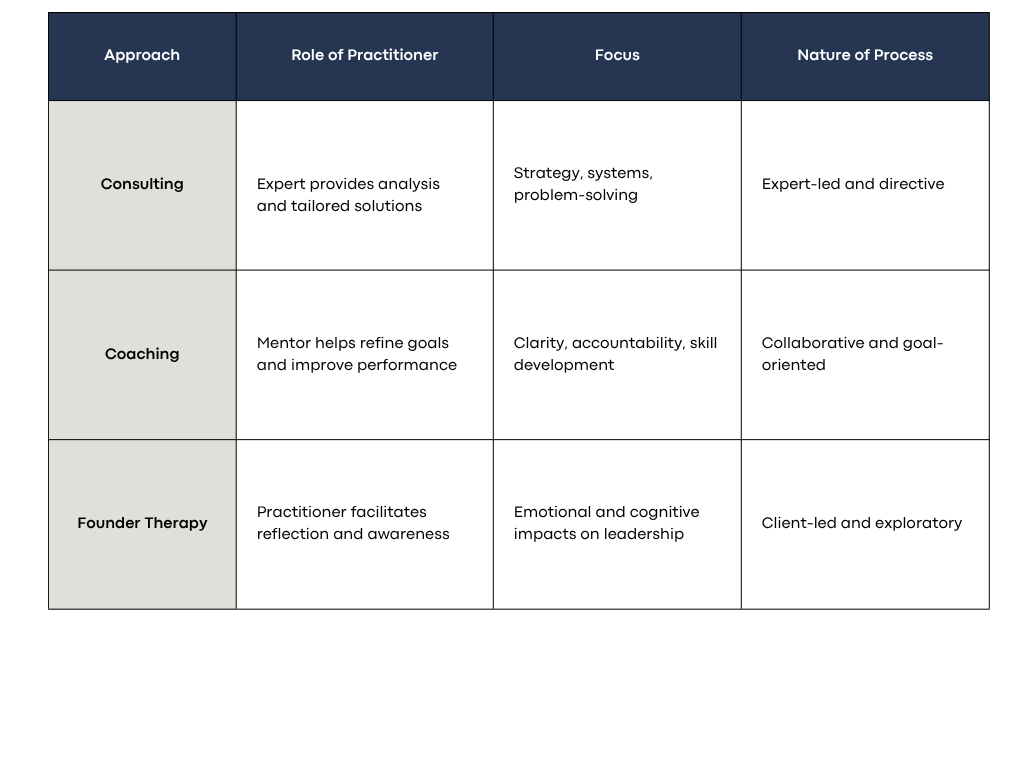
A consultant brings expertise — they analyse, advise, and design tailored solutions to solve business problems. Their role is directive: they tell you what to do.
A coach supports your performance and growth. They ask sharp questions, challenge assumptions, and help you turn goals into action. Their role is collaborative: they help you do it better.
Both are valuable. But they tend to focus on the external — systems, goals, and behaviours — rather than the emotional forces shaping how you show up to lead.
Founder Therapy: Working On the Person Leading the Business
Founder Therapy starts from a different angle.
It’s less about what needs to happen in the business, and more about what’s happening in you as you lead it.
Instead of frameworks and action plans, the focus is awareness — understanding the emotional patterns that influence your decisions, relationships, and leadership style.
The process is client-led. There’s no agenda or performance target. It’s a confidential conversation that helps you notice what’s driving you — fear, anger, shame, or self-doubt — and how those emotions shape what you do next.
Because often, what keeps you stuck isn’t strategic. It’s emotional.
The Emotional Side of Leadership
When pressure builds, most founders respond the same way: push harder, think faster, work more. But emotion doesn’t disappear just because you outthink it.
Fear can lead to control, overthinking, or avoiding conflict.
Anger can turn into impatience, frustration, or resentment.
Shame hides behind perfectionism, comparison, or that sense of never quite enough.
These emotions quietly shape how you make decisions, manage people, and communicate.
Coaching can help you manage those moments. Founder Therapy helps you understand them — so you can respond with clarity instead of habit.
Which One Do You Need Right Now?
If your challenges are strategic — revenue, systems, hiring — coaching or consulting makes sense.
If you’re noticing patterns — burnout, reactivity, communication breakdowns, or the feeling that you’re “doing everything right but still not at ease” — that’s where Founder Therapy fits.
You don’t have to choose one forever. Many founders find that once they start doing the inner work, coaching and business strategy become far more effective.
Which One Do You Need Right Now?
If your challenges are strategic — things like revenue, systems, or hiring — coaching or consulting can help you build plans and structure.
But those decisions are never purely strategic. Fear, shame, and anger all have a way of shaping how — and when — those decisions get made.
Founder Therapy supports that process from the inside out. It helps you understand what’s driving your choices, the emotions at play beneath the surface, and how to approach strategy with a clearer head.
You don’t have to choose one approach. In fact, many founders find that doing the inner work makes the strategic work far more effective.
Getting Started
Founder Therapy isn’t about advice or frameworks. It’s about creating space to see yourself more clearly — to understand the emotions that influence your leadership and the decisions you make every day.
If you’re curious, start with a short introductory call. It’s a relaxed chat to see if the process feels right for you and to go over how sessions work — format, pricing, and frequency.
Final Thought
Consulting helps you solve problems.
Coaching helps you perform better.
Founder Therapy helps you understand yourself as you lead.
The better you understand yourself, the easier everything else becomes to navigate.
